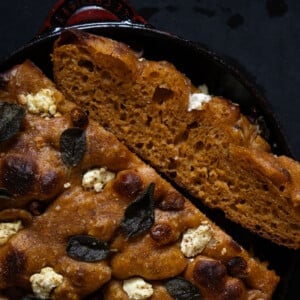
Crisp yet ultra plush and with pockets of caramelized maple garlic, goat cheese and sage, this sourdough pumpkin focaccia is bound to tickle all your taste buds.

Pumpkin Sourdough Focaccia
with caramelized maple garlic (goat cheese ‘n sage)!
Honestly honestly? Few things excite me less than pumpkin nowadays– a flavor so overplayed courtesy of the PSL craze, that us food bloggers have spent the past five years hyping up pumpkin spice more than its worth (quite arguably).
But savory pumpkin is a whole other ball game, adding just the right amount of sweetness to play beautifully with warm herbs (sage hits a home run for me every time as its subtle yet distinct)(but fresh thyme and oregano would do wonders here too). Goat cheese really is non negotiable here for me (if dairy is your thing), but what really takes it over the top are the little cloves of caramelized maple garlic.
These little pockets of heaven are incredibly simple to make, albeit a tad time consuming. But all they are are roasted garlic in olive oil, then finished off with some maple syrup until fully caramelized. And yes, these are a terrific addition to a charcuterie board (they spread beautifully on toast too) and they also add a really nice touch to anything from salads to leftover sandwiches.
p.s. if adding cheese, just be mindful that if you aren’t finishing your focaccia in one go you don’t want to bake any dairy in it (as you always want to store your sourdoughs at room temp)(i.e. just sprinkle it before serving or before reheating).
p.p.s. I used a Guinness beer in lieu of spring water for the hydration and it added truly mind blowing complexity flavor and aroma wise (you must take plenty of whiffs even during the proofing process pretty please). Oh and get the cans, you get more bang for your buck and a more “draft like” experience.

the deets
Sourdough bread recipes are, more often than not, given in percentages (as this allows bakers to scale with ease)(and it comes particularly handy with focaccia as it needs to be scaled up or down depending on your chosen baking dish). Say, for my 9 inch cast iron I use the same amounts as I would with a regular loaf (it comes out a little thicker than traditional focaccia would, so it would also be a suitable amount for a half tray).
The pumpkin sourdough recipe: 50% hydration, 20% active starter, 10% honey, 80% pumpkin puree, 2% kosher salt (plus extra virgin olive oil aplenty to handle).
- starting flour amount: 500g unbleached bread flour = 100%
- hydration: 250g Guinness beer (or spring water) = 50% hydration (= 250g/500g x 100% = 50%)
- active starter: 100g (= 100g/500g x 100% = 20%)
- honey: 50g (= 50g/500g x 100% = 10%)
- pumpkin puree: 200g (= 200g/500g x 100% = 40%)
- salt: 10g = 2% (= 10g/500g x 100% = 2%)

the video story 📹

Sourdough Pumpkin Focaccia (with caramelized maple garlic!) 🍁
Equipment
- cast iron skillet or half tray (it will come out a more "traditional" thickness
Ingredients
- 250 g Guinness beer or spring water*
- 200 g pumpkin puree
- 100 g active starter
- 50 g raw honey
- 500 g strong bread flour **
- 10 g sea salt
for the toppings
- 2 heads garlic baked at 400°F (200°C) for 40 to 45 minutes until the cloves turn soft
- 2 tablespoons extra virgin olive oil
- 1/4 cup maple syrup
- 1/2 cup goat cheese ***crumbled
- handful sage leaves
Instructions
make your dough
- Add the beer or water (preferably at room temp), pumpkin puree, active starter and honey to a large bowl. Using your hands (though some peeps favor a danish hook) mix until thoroughly dissolved.
- Add in the flour and salt and mix with your hands until just combined and the dough is all shaggy (and sticky).
- Cover with a kitchen towel and let it rest for 30 minutes.
30 mins later: bulk rise (plus stretch ‘n folds)
- Thirty minutes in you’ll want to do a set of “stretch ‘n folds”: grab a hold of the dough, stretch it upwards and fold it down towards the center of the bowl. Rotate and repeat four times.
- Repeat three more times every thirty minutes (sourdough pumpkin baked goods take a little longer to develop gluten, so its important to do a few sets!).
- Drizzle olive oil onto a medium sized bowl and transfer the dough gently (as its easier to gauge the rise if you can actually mark it with a sharpie) and cover with a kitchen towel.
- Allow to rest for 3-8 hours, or until *just* doubled in size (remember that time here is directly influenced by temperature so it’ll vary greatly). And unlike regular sourdough loafs, I actually don’t let my dough triple at room temperature here as I prefer to now pop it in the fridge so I can bake it *exactly* when I want.
optional: cold proof
- Cold proofing here helps to develop flavor further (and allows you to gauge more accurately to bake when needed), but you can also skip it.Transfer the dough to the fridge once it has doubled in size. Just note that this one ferments very quickly in my experience, so just do 24 hours (or make sure that it doesn’t triple in size!).vip note; I know some folk like to transfer it to the fridge already in its baking dish (effectively doing the second rise as a cold proof as we do with regular sourdough loafs), but imo doing the second proof at room temp works best when it comes to sourdough focaccia given that we’re throwing olive oil in the mix (fats really do make the culture work so much harder, which is why so many sourdough recipes out there for focaccia also add a tablespoon of active yeast).
2-4 hours before baking: “shape”
- Lucky for us focaccia doesn’t require actual shaping, but I do like to give it a couple folds with olive oil when transferring it onto your baking dish of choice from the fridge (think of it as a gentler alternative to punching the dough, while beginning to incorporate layers of flavor).
- Allow to proof at room temperature for about 2 -4 more hours, or until super bubbly and doubled in size (see video for reference).another vip note: your focaccia may stick somewhat to pretty much any baking dish you use. Some folk like to grease them with butter (I don’t as it does change the taste profile) and others line the dish with parchment paper (I don’t either as the crust ends up significantly less crisp)– just expect your focaccia to stick slightly in certain parts, but as long as it’s oiled well enough it’ll still come out with a nudge (or five).
make your caramelized maple garlic
garnish ‘n bake away!
- Preheat oven to 425°F/220°C and mix your topping ingredients in a small bowl, seasoning to taste.
- Drizzle more evoo on top your focaccia dough and, using your hands, dimple it in while giving it a little wiggle to break up the biggest bubbles. Nestle in garlic cloves bathed in maple syrup and herbs.
- Bake for approximately 45-50 minutes if using a skillet (and about 35-40 if using a larger baking dish). I like to place a dome of aluminum on it once I see it beginning to overly brown (just be sure to place it strategically to allow the steam to escape so it still crisps up)(and also feel free to drizzle in a touch more evoo during baking if you see the top is looking a little dry).
- Hold your horses for 15-20 minutes before serving (it’ll still be warm, worry not!)(we just don’t want to wreck our crumb ok?).
- Sit, enjoy, be present and enjoy the satisfying fruits of your hard work (and store at room temp in an airtight container for a few days).
Video

Oh and one last thing, could I use a diffrent beer like an IPA?
Hi, would it be okay to sub the honey for brown sugar? Thanks in advance!
This is low carb? I see beer, honey and bread flour and wonder how?
The opening paragraph of the instruction is somewhat unclear. Am I adding the 50g of flour and spring water to the 100g of starter? Or am I feeding my starter and then separating out 100g to use in the recipe?
This seems neither gluten free nor keto…?
I’m confused, I thought your site was all things gf and keto as your blurb under your photo says.
Hello! This will be my first attempt at making sourdough. I just wanna be clear, so I’m adding 50 g of flour to my 100 grams of starter that I have and then I’m adding roughly 50 g of water to that?
It would be incredibly helpful if you begin to clearly label your recipes when they are non-keto. Love, love your pages and even purchased your cookbook along with your pasta line when you had it. As a frequent user, the low- carb users, I’m sure would be grateful for an easy divide of food resources on your site.
An other great recipe. this cheese with garlic is delicious. Thanks a lot for all your work. It has change my way of eating.
Hello Paola! Forgive me if I’ve missed something but how is this recipe GF or keto? It looks amazing but with strong bread flour your using it is lost on me. Do you have recommendations on how to adapt to a GF alternative? I visit your sight often. Thanks for any guidance and your awesome site.
Sounds yummy! I still need to get “good” with sourdough, my brain is still trying to understand all the hydration% , probably I just need to spend more time with it, but I haven’t made it a priority yet.
Honestly Donna? You can bake terrific sourdough and not even understand hydration percentages! I’ll always include it in the posts, but I’m going to be placing a lot more emphasis on “getting to know your starter and dough”- as that really is the foundation to great bakes (so you’ll begin to understand how things such as hydration affect your dough with practice rather than as percentages on a screen).
Hi, make all my bread with KA bread flour, it just makes an amazing product!
I will be making this bread for an event and need to make 12 at a time. Do you have any suggestions on how to go bout this? I will be starting my R&D this week and would love any advice that you may have. My starter is about 6 months old and so far has made some great breads. However I am still learning and I look forward to your advice
Thank you
Daphne Valerin
I don’t see the instructions on making the caramelized garlic. Any specific suggestions there?
I also wanted to let you know the baking portion of your instructions could use some editing. It looks like you copied the text from a different recipe but didn’t update the ingredients.